Thursday, 29 May 2014

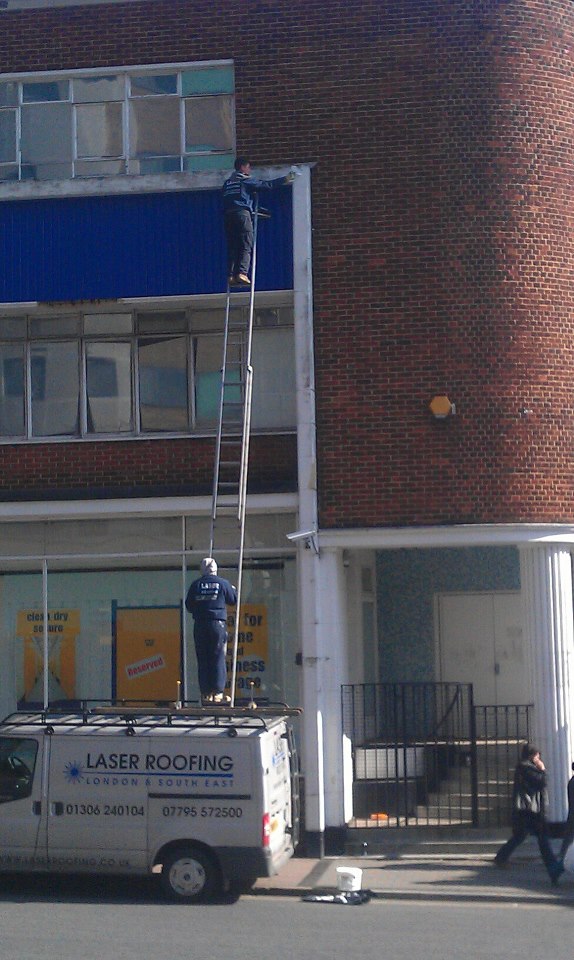
Roofer fined after footing an extending ladder from top of van

George Nicholls, trading as Laser Roofing London and South East Roofing Limited, was fined after footing a double extension ladder on a transit van in order to access a third floor façade on 14 March 2013.
The circumstances were:
  • Mr Nicholls had been sub-contracted by Norfolk-based Maintenance 24-7 Ltd for the paint job because the company did not possess the correct equipment or expertise.
  • A pavement licence should have been obtained to create a properly segregated safe-working area, but was not. 
  • Therefore, there was no form of segregation to prevent vehicles or pedestrians from passing under or near the work area.
  • Ladders were specified as the chosen method of work.
  • Scaffolding or a mobile elevated work platform would have provided a safer option for accessing the façade.
  • After the finding the façade was higher than the ladder he had with him, the roofer opted to improvise.
  • He placed it on the roof of his van and worked from it fully-extended some eight metres above the ground with a labourer providing the footing.
Maintenance 24-7 Ltd, was fined £10,784 (inc. costs.)
George Nicholls was fined £4,666 (inc. costs). 
The HSE Inspector said:
“The photographic evidence speaks for itself in terms of the risks created. Anyone can see the system of work is plain wrong, so why a supposedly competent roofer chose to work in this way is anyone’s guess. George Nicholls blatantly and recklessly risked harming himself and others, and he did so on behalf of Maintenance 24-7 Ltd, who had clear duties of their own to ensure the work at height was properly planned, managed and executed in a safe manner. The standards of both parties fell far below those required, and I would like to thank the concerned member of the public who initially brought the matter to the council’s attention.”

Fingers crushed in due to inoperable interlocked guards

Clondalkin Pharma & Healthcare (Kimbolton) Ltd, of  Portishead, Bristol, was fined £13,890 (inc. costs) after an employee had two fingers crushed in unguarded machinery.
The circumstances were:
  • The label printing machine on which the accident occurred and a further three printing machines at the factory had inoperable interlocked guards.
  • Despite having assessed the risks, the company did not identify this danger and instead relied on instructing operators to close the guards.
  • An employee was trying to clear a piece of adhesive from the anvil of the machine while it was running, which he could do because of the defective interlocks 
  • His right hand became caught and two of his fingers got crushed in an unguarded in-running nip. 
  • He subsequently made a full recovery

The HSE Inspector said:
“This case highlights the need for employers to assess risks adequately. It is a well-known fact that unguarded printing machines can cause major injuries and Clondalkin should have known better than to let its workers use inadequately-guarded machinery. Instructing operators to close guards is not reliable enough, as this incident demonstrates. Guards on machinery are there for a reason and they should be maintained in working order and checked for possible failures regularly. Had the guards been operational on the machine this worker used, he would not have had to suffer such a painful injury.”

Tuesday, 27 May 2014

Veetee Rice fined again because of overridden interlock.

Veetee Rice of Rochester was fined £35,000 (inc. costs) on 27 May 2014 after worker was injured due to overridden guard interlock.
The circumstances were:
  • The machine attached labels to packets of rice.
  • An interlock on a guard on the conveyor rollers and labeller had been deliberately defeated.
  • On 27 March 2012, when the machine failed to stick a label to a box, it ended up on one of the unguarded rollers. 
  • A worker, Khalil Ahmed tried to pull it off but his right hand became trapped, injuring three fingers.
  • In November 2009, the company was fined £140,000 for similar failings relating to unguarded machinery that led to the death of one of its employees.

The HSE Inspector said:
“Mr Ahmed was fortunate he was not more seriously injured and suffered no long term affects. It was an entirely preventable incident. The risks of production machinery are well recognised in the industry and Veetee Rice Ltd should have ensured that all machinery guarding mechanisms were not just in place but functioning properly. Veetee Rice Ltd was sentenced for an offence brought under the same Regulations just three years earlier, for a 2006 fatality of one of their staff, and patently did not sufficiently learn from that experience and the lessons it offered. Food production has one of the worst safety records within the manufacturing sector. Guards are critically-important elements and they can and do save injury and even life when working as they are intended.”

Saturday, 24 May 2014

Newquest fined after worker was caught in press

Newsquest Media was fined  £4,560 (inc. costs) after a worker was injured when his hand was caught in a rotating printer roller.
The circumstances were:
  • On 6 February 2013 the employee and colleagues had been having problems with paper breaking and wrapping itself around ink rollers.
  • Sections of the press had been removed to clear paper from the ink rollers and had not been replaced.
  • It was a regular practice of print room staff to deal with paper breaks in this way.
  • He cleared most of the paper and set the machine running at a medium speed. 
  • He noticed a bit of paper still on the roller and tried to brush it off with a piece of cloth. 
  • As he did, the cloth was dragged into the nip of the ink roller, injuring his right hand.

The HSE Inspector said:
“This was an easily preventable incident. If Newsquest had ensured its employees ran the press with the machine rollers not exposed, there would have been no injury. It was only down to luck that an incident had not happened before and also that this injury was not more serious. It is critical that companies make sure that effective guards are in place on machinery to protect their employees from dangerous moving parts. If there is a part of a machine that serves another purpose but is protecting staff from contact regardless, then it needs to be treated as a guard.”

Heinz fined after worker's hand is severed by machine

Heinz was fined £59,661 (inc. costs) on 16 May 2014 after an engineer had his hand severed when it became trapped in live, unguarded machinery at its Norfolk plant.
The circumstances were:
  • Alec Brackenbury was servicing a potato peeling machine at Heinz’s Westwick plant on 20 June 2013.
  • This machine was electrically isolated and locked off.
  • An associated slurry pump which seemed to be part of the same machine had a separate supply.   
  • Mr. Brackenbury was unaware of this and believed he had isolated the pump along with the peeler at the main distribution box.
  • A protective grate bolted on top of the pump to prevent access, was absent, enabling Mr Brackenbury to reach into the screw auger of the pump.
  • As he tried to retrieve a dropped bolt, he put his hand into the slurry pump below, which operated and severed his right hand.

The HSE Inspector said:
“Mr Brackenbury suffered a horrific injury in an incident that was wholly avoidable. Maintenance activities on production machinery will invariably involve additional hazards beyond those present in normal operation. Mr. Brackenbury was put at risk by Heinz Ltd’s inadequate assessment of risks and lack of effective measures to stop access to dangerous parts of equipment. It is the duty of the employer to ensure their employees and contractors can carry out their work safely. Sadly in this case Heinz failed to protect Mr Brackenbury while he was contracted to carry out maintenance work at their Westwick plant and, as a result, he has suffered a life-changing injury.”

Poor planning of decommissioning work at smoothie factory causes 24 year old's death

Gerber Juice, now trading as Refresco Gerber UK Ltd, an international smoothie and fruit juice company was fined £155,000 (inc.costs) after an engineer was killed by falling pipework during decommissioning work.
The circumstances were:
  • Gerber Juice were decommissioning a factory in Llantrisant and moving equipment to Somerset.
  • The factory had become a construction site with Gerber electing to plan, manage and monitor the project themselves instead of appointing a competent Principal Contractor.
  • Gerber had overlooked various hazardous tasks because they had not contracted the specialists to do it.
  • Work, including the removal of overhead industrial pipes and their supporting structures fell to the in-house engineers.
  • A production manager for the juice factory was in charge of the hazardous decommissioning project, despite never having done this work before or having received any formal training. 
  • A safety officer only visited once or twice a fortnight and was based in Somerset.
  • This work had not been adequately planned, risk assessed, communicated or monitored by management, 
  • The safety systems that Gerber used to manage its specialist contractors had not been used to manage its own engineering staff on the same site.
  • Gavin Bedford was helping to dismantle and demolish a section of industrial pipework
  • Because there was no written plan explaining how the structure was to be taken apart, various bolts and structural elements were removed in an unsafe sequence. 
  • This led to the eventual collapse of the structure, weighing around 300kg, which structure Mr Bedford.
  • He sustained critical head injuries and died three days later in hospital

The HSE inspector said:
“Gavin Bedford, a young hard-working and highly-regarded engineer, was killed because of Gerber’s basic corporate failure to plan, manage and monitor a construction project. “Any demolition or dismantling work must be set down in writing and strictly monitored – as the law requires. It is also basic common sense. If Gerber had given enough time at the beginning to think through what needed to be done, and how it should be done, then Gavin would still be here today.”

Binding machine causes lost finger and £14,000 fine

Ashford Colour Press Limited, of Gosport, was fined  £14,278 (inc. costs) after an employee was injured on a binding machine.
The circumstances were:
  • An employee, Ms Bull, was attempting to clean the milling blades on the large binding machine and had removed a fixed guard to access the parts.
  • At the same time a fellow worker changed a milling bag where paper dust is collected.
  • The machine was restarted when Ms Bull was still working with the fixed guards open. She was unable to react in time and the moving blades caught her fingers.
  • She had to have the middle finger of her right hand amputated.

The HSE Inspector said:
“This was an easily preventable incident that has left a young worker with an irreversible hand injury. The system of work was inherently unsafe because it should not have been possible to operate the machine with dangerous moving parts exposed. It is vital that all maintenance work, however routine, is properly planned and assessed, and that suitable protection measures are implemented. That is especially true when you are dealing with powerful equipment like the binding machine that injured Leharna.”