Wednesday, 29 April 2020

E.G.L. Homecare fined £85,000 after worker's arm was caught in exposed rollers

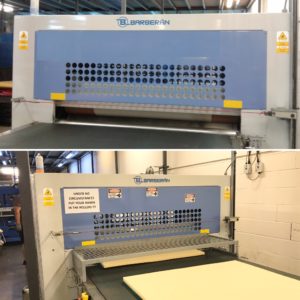
E.G.L. Homecare Limited were fined £85,314 (inc.costs) after an agency worker was caught in a poorly-guarded machine.
The circumstances were:
  • The machine was a press which was part of a line that glued sponge to abrasive sheets to make scourer sponges.
  • There was no tunnel guard to prevent access to the rollers of the machine.
  • On 19 June 2019 a worker was operating the machine where he had to remove the sheets of scourer sponges from the conveyor onto a pallet.
  • He attempted to remove dirt from a press roller.
  • His right hand got dragged into the nip point of two in-running rollers up to his shoulder. 
  • He was diagnosed with forearm compartment syndrome, a painful condition caused by bleeding or swelling within an enclosed bundle of muscles. 
  • He had an operation on his arm and had to stay in hospital for six days.
The HSE inspector said:
“This incident could have been avoided had the company properly assessed the guarding arrangements on the machine when it was installed. Unfortunately access to in-running rollers is a common cause of injury but it can be easily avoided by providing effective control measures such as the provision of tunnel guards.”

What will happen to CE marking because of Brexit?


The CE mark was introduced to facilitate trade between EU countries.  
It is likely that after the end of 2020, this mark will be replaced by the UKCA mark for equipment made and staying in the UK.
Of course, the primary function of the CE mark within the UK is no longer relevant, but the secondary function of signifying that the equipment meets certain requirements will be met by the new mark.

Note that:
The UKCA mark has still to be ratified by Parliament
The UKCA mark must not be used until at least 1st January 2021.

The situation after 2020 is likely to be:
  • Equipment made within the UK and remaining within the UK will have the UKCA mark.
  • Equipment made within the UK and shipped to the EU will have the CE mark.
  • Equipment made within the EU and imported into the UK will have the CE mark.

There is, as yet, no definition of requirements for equipment made outside the UK and EU and imported into the UK.  However, it is logical that the UKCA mark and the actions behind it will be required.

The dates are correct at the time of writing this, but the delays caused by the Covid19 pandemic may change these.


Tuesday, 17 March 2020

T M Telford Dairy fined £600,000 after 2 employees were showered in hot, acidic cleaning fluid

Yogurt manufacturing company T M Telford Dairy Ltd was fined £614,379 (inc.costs) after two employees suffered serious injuries following the release of an acidic cleaning solution.
The circumstances were:
  • The accident occurred when removing valves.
  • There was no risk assessment in place.
  • There was no safe system of work in place for the safe removal of valves.
  • The two engineers involved had had no formal training in lock-off and isolation procedures. 
  • Nor had they received training in use of permits to work.
  • The two men were  working on a faulty valve on a CIP (cleaning in place) system.
  • The valve blew off under pressure.
  • Cleaning fluid containing 1% nitric acid at 650C surged out, hitting the roof overhead and spraying the employees.
  • Whilst trying to escape from the acidic cleaning fluid, one of the engineers fell from a hooped ladder and sustained a head injury.

The HSE inspector said: 
“Those in control of work have a responsibility to assess the risks and implement safe methods of working and to provide the necessary information, instruction and training to their workers in a safe system of working. If a suitable safe system of work had been in place prior to the incident, the injuries sustained by the employees could have been prevented”.

Chesterfield Poultry Ltd fined £300,000 when lack of emergency stop cause loss of worker's thumb

Poultry processing company Chesterfield Poultry Ltd was fined £305,046 (inc. costs) for safety breaches after an agency worker had her thumb severed on a moving part of a processing line.
The circumstances were:
  • The accident occurred on an overhead conveyor for transporting chicken bodies.
  • There was no emergency stop by the injured person's work station.
  • On 24 April 2017, the worker was rehanging chickens on a hook on the conveyor.
  • One of the chicken's feet came out of the hook.
  • The worker  went to insert the foot back into the hook.
  • Her thumb got stuck, and she was pulled around with the conveyor.
  • She was unable to stop the conveyor.
  • Further around the line there was a fixed upright post attached to a drip tray.
  • As she got to this point her thumb met the post and her thumb was traumatically severed.

The HSE inspector Tarn commented:
“The moving shackles passing the fixed pole – that supported the drip tray – created the danger zone that the worker was drawn into. Companies must ensure that measures are in place to prevent access to dangerous parts of machinery and provide a means to stop machinery should an emergency happen.”

Friday, 6 March 2020

De La Rue International Limited fined £300,000 after employee was caught in paper-making machine

De La Rue International Limited were fined £311,191 (inc.costs) after an employee suffered life changing injuries at their paper mill site near Bath.
The circumstances were:
  • De La Rue International Limited had not provided a safe system of work for the removal of broken paper from the paper-making machine. 
  • Specifically there was no safe system of work for removal of paper from the after-dryer section of the paper-making machine when the machinery was operated in reverse.
  • On 16 March 2017, an employee was helping colleagues to remove paper from the machine.
  • He was standing in the gap between the size press and the after-dryer section of the machine.
  • A fixed guard had been removed.
  • He expected the spar drum to come towards him.
  • However, it moved in the opposite direction.
  • By the time he realised this, the spar drum had turned and his head became trapped between a spar and the base of the fixed guard.
  • He required a nine-hour operation in hospital for facial reconstruction.

The HSE inspector said:
“Those in control of work have a responsibility to de
vise safe methods of working and to provide the necessary information, instruction and training to their workers in the safe system of working. If a suitable safe system of work had been in place prior to the incident, the life changing injuries sustained by the employee could have been prevented.

UK Mail fined £400,000 for 2 forklift truck accidents

UK Mail was fined £409,356 (inc. costs) after two employees were injured by fork lift trucks in two separate incidents.
The circumstances were:
  • UK Mail failed to ensure that there was effective segregation of pedestrians and vehicles. 
  • There were no pedestrian walkways for employees to navigate across the warehouse safely.
  • On 20 October 2016 an operations administrator was struck by forklift truck whilst sorting the returned parcels and sustained a fractured skull and bleed between the skull and brain. 
  • On 20th March 2017 a warehouse operative was inspecting a parcel and a fork lift truck hit the left side of her body. She suffered nerve damage to her left arm and superficial leg and hip injuries

The HSE inspector said:
“The company failed to properly manage workplace transport in the warehouse area. The systems of work in place were not safe. Adequate control measures were not identified or implemented, and effective segregation was not in place, nor, even adequate workways.  The incident heightens awareness of the need to properly assess and control the risks to employees from workplace traffic movements and a reminder that these types of failures can lead to life-changing injuries.”

Thursday, 20 February 2020

Lymington Precision Engineers fined £24,000 for failing to control risks from metalworking fluids.

Engineering company Lymington Precision Engineers Co Limited was fined £24,447 (inc.costs) for failing to control the risk of its employees developing dermatitis following exposure to metalworking fluid.
A visit by the HSE found the company had failed to ensure that adequate measures were in place for the control of exposure to metalworking fluids, exposing their employees to the risk of contracting dermatitis.
The HSE inspector said:
“This case could so easily have been avoided by simply implementing correct control measures and appropriate working practices. Appropriate controls could include provision and use of well-fitting overalls, use of gloves in contact with contaminated work pieces, avoidance of the use of airlines for cleaning activities, and the provision of an effective skin care regime. Control of exposure to hazardous substances is a legal requirement on employers and HSE provides guidance on how control can be achieved.”
It is interesting that no mention is made of the requirement for local exhaust ventilation (LEV).  This could have arisen because either:
  • The LEV was adequate, in which case the company had taken the primary steps to control respiratory ill health from metalworking fluids,
  • The HSE's press release (from which this blog is derived) failed to mention a key requirement, or
  • There is a mismatch in HSE stances on metalworking fluids in applying indg365.pdf.

For those in the Bristol area, do come along to the IOSH Bristol and West presentation on the health risks, assessment and control of metalworking fluids and mild steel welding fume, given by an HSE occupational health specialist.
The date and time are 11th June 2020, from 13:00 to 15:00 and the location is the BAWA Club, Filton, BS34 7RG.  
It's free and IOSH Bristol and West go out of our way to make you welcome.