Thursday, 28 May 2020

Modus Workspace fined £1.1 million + costs after worker fell from ladder

London-based relocation and refurbishment company Modus Workspace Limited, was fined £1.1 million plus costs of £68,116 after a worker was seriously injured when he fell from height.
The circumstances were:
  • Modus Workspace Limited were the principal contractor at a site in Hemel Hempstead. 
  • On 5 September 2016, an engineer was testing a sprinkler system for leaks. 
  • Modus failed to provide reasonably practicable measures to prevent a fall from the internal roof and was therfore not meeting their obligations as principal contractor.
  • This applied to both the engineer and other contractors working on the roof.
  • He climbed onto an internal roof and used an extension ladder to inspect the leak.
  • The ladder slipped away from him.
  • He fell almost three metres into the gap between the internal roof and the external wall. 
  • He suffered severe blood loss, amounting to around half of his bloodstream. He required a blood transfusion and needed 14 stiches to his head.  
  • He also sustained a fractured vertebrae and suffered soft tissue damage.

The HSE inspector said: “This case highlights the importance of taking reasonably practicable measures when planning and managing the risks regarding work at height within the construction industry. Falls from height remain one of the most common causes of work-related fatalities and injuries in this country and the risks and control measures associated with working at height are well known. The engineer’s injuries were life changing and he could have easily been killed. This serious incident and devastation could have been avoided if basic safety measures had been put in place.”

Phillips 66 fined £1,2 million after accident with high pressure, high temperature steam

Oil refinery company, Phillips 66 Ltd was fined £1.2 million + costs for safety breaches after two workers in North Lincolnshire suffered life-changing injuries from an uncontrolled release of high pressure and high temperature steam.
The circumstances were:

  • Phillips 66 Limited’s had a safe system of work which included isolating plant.
  • On  30 October 2013, two workers were  re-assembling high pressure steam pipework following maintenance of a steam turbine driven pump.
  • A number of personnel involved in the implementation of the company’s safe isolation procedure of the steam system failed to complete all the required checks and verifications.
  • During the re-assembly, the two workers were exposed to an uncontrolled release of high pressure, high temperature steam of around 250oC.
  • One worker, who was 53 years old, received burns to his lower back and legs.
  • The other, a 20-year-old apprentice, received extremely serious burns to his torso, chest, arms and legs. At the time of the incident, these injures were life threating.
  • The company was fined £1.2 million and ordered to pay £20,450 in costs
The HSE inspector said:
“Safe systems of work procedures are in place to ensure the health and safety of workers. Companies should ensure that all relevant employees and personnel who are involved in their operation and execution are suitably trained and competent to complete their roles within the system. 
Where a significant risk gap leads to an incident which results in injury to workers, HSE will take the appropriate enforcement action irrespective of the size of the organisation.”


Wednesday, 29 April 2020

E.G.L. Homecare fined £85,000 after worker's arm was caught in exposed rollers

E.G.L. Homecare Limited were fined £85,314 (inc.costs) after an agency worker was caught in a poorly-guarded machine.
The circumstances were:
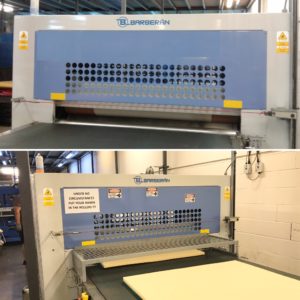
  • The machine was a press which was part of a line that glued sponge to abrasive sheets to make scourer sponges.
  • There was no tunnel guard to prevent access to the rollers of the machine.
  • On 19 June 2019 a worker was operating the machine where he had to remove the sheets of scourer sponges from the conveyor onto a pallet.
  • He attempted to remove dirt from a press roller.
  • His right hand got dragged into the nip point of two in-running rollers up to his shoulder. 
  • He was diagnosed with forearm compartment syndrome, a painful condition caused by bleeding or swelling within an enclosed bundle of muscles. 
  • He had an operation on his arm and had to stay in hospital for six days.

The HSE inspector said:
“This incident could have been avoided had the company properly assessed the guarding arrangements on the machine when it was installed. Unfortunately access to in-running rollers is a common cause of injury but it can be easily avoided by providing effective control measures such as the provision of tunnel guards.”

What will happen to CE marking because of Brexit?


The CE mark was introduced to facilitate trade between EU countries.  
It is likely that after the end of 2020, this mark will be replaced by the UKCA mark for equipment made and staying in the UK.
Of course, the primary function of the CE mark within the UK is no longer relevant, but the secondary function of signifying that the equipment meets certain requirements will be met by the new mark.

Note that:
The UKCA mark has still to be ratified by Parliament
The UKCA mark must not be used until at least 1st January 2021.

The situation after 2020 is likely to be:
  • Equipment made within the UK and remaining within the UK will have the UKCA mark.
  • Equipment made within the UK and shipped to the EU will have the CE mark.
  • Equipment made within the EU and imported into the UK will have the CE mark.

There is, as yet, no definition of requirements for equipment made outside the UK and EU and imported into the UK.  However, it is logical that the UKCA mark and the actions behind it will be required.

The dates are correct at the time of writing this, but the delays caused by the Covid19 pandemic may change these.


Tuesday, 17 March 2020

T M Telford Dairy fined £600,000 after 2 employees were showered in hot, acidic cleaning fluid

Yogurt manufacturing company T M Telford Dairy Ltd was fined £614,379 (inc.costs) after two employees suffered serious injuries following the release of an acidic cleaning solution.
The circumstances were:
  • The accident occurred when removing valves.
  • There was no risk assessment in place.
  • There was no safe system of work in place for the safe removal of valves.
  • The two engineers involved had had no formal training in lock-off and isolation procedures. 
  • Nor had they received training in use of permits to work.
  • The two men were  working on a faulty valve on a CIP (cleaning in place) system.
  • The valve blew off under pressure.
  • Cleaning fluid containing 1% nitric acid at 650C surged out, hitting the roof overhead and spraying the employees.
  • Whilst trying to escape from the acidic cleaning fluid, one of the engineers fell from a hooped ladder and sustained a head injury.

The HSE inspector said: 
“Those in control of work have a responsibility to assess the risks and implement safe methods of working and to provide the necessary information, instruction and training to their workers in a safe system of working. If a suitable safe system of work had been in place prior to the incident, the injuries sustained by the employees could have been prevented”.

Chesterfield Poultry Ltd fined £300,000 when lack of emergency stop cause loss of worker's thumb

Poultry processing company Chesterfield Poultry Ltd was fined £305,046 (inc. costs) for safety breaches after an agency worker had her thumb severed on a moving part of a processing line.
The circumstances were:
  • The accident occurred on an overhead conveyor for transporting chicken bodies.
  • There was no emergency stop by the injured person's work station.
  • On 24 April 2017, the worker was rehanging chickens on a hook on the conveyor.
  • One of the chicken's feet came out of the hook.
  • The worker  went to insert the foot back into the hook.
  • Her thumb got stuck, and she was pulled around with the conveyor.
  • She was unable to stop the conveyor.
  • Further around the line there was a fixed upright post attached to a drip tray.
  • As she got to this point her thumb met the post and her thumb was traumatically severed.

The HSE inspector Tarn commented:
“The moving shackles passing the fixed pole – that supported the drip tray – created the danger zone that the worker was drawn into. Companies must ensure that measures are in place to prevent access to dangerous parts of machinery and provide a means to stop machinery should an emergency happen.”

Friday, 6 March 2020

De La Rue International Limited fined £300,000 after employee was caught in paper-making machine

De La Rue International Limited were fined £311,191 (inc.costs) after an employee suffered life changing injuries at their paper mill site near Bath.
The circumstances were:
  • De La Rue International Limited had not provided a safe system of work for the removal of broken paper from the paper-making machine. 
  • Specifically there was no safe system of work for removal of paper from the after-dryer section of the paper-making machine when the machinery was operated in reverse.
  • On 16 March 2017, an employee was helping colleagues to remove paper from the machine.
  • He was standing in the gap between the size press and the after-dryer section of the machine.
  • A fixed guard had been removed.
  • He expected the spar drum to come towards him.
  • However, it moved in the opposite direction.
  • By the time he realised this, the spar drum had turned and his head became trapped between a spar and the base of the fixed guard.
  • He required a nine-hour operation in hospital for facial reconstruction.

The HSE inspector said:
“Those in control of work have a responsibility to de
vise safe methods of working and to provide the necessary information, instruction and training to their workers in the safe system of working. If a suitable safe system of work had been in place prior to the incident, the life changing injuries sustained by the employee could have been prevented.