Tuesday, 9 August 2022

B&M fined £1M after electrical explosion at their warehouse

Retail company B&M were fined £1,000,000 after an electrician suffered serious burns to 15 per cent of his body when he was caught in an explosion at a warehouse in Liverpool.
The circumstances were:
  • On 22 September 2018, an electrician was attempting to connect a generator to B&M’s Low Voltage supply in order to allow B&M to operate some of its core site functions whilst high voltage maintenance was being undertaken. 
  • This work was complex involving several contractors and required co-ordination of different working parties with specific time limited requirements. 
  • There was insufficient planning between parties beforehand including who was in charge of each site, coordination of work and exchange of relevant documentation.
  • B&M failed to appoint a suitably competent person to plan and carry out the work to connect temporary generators to their distribution board at the premises.
  • Electrical contractors Daker Ltd.’s work methods fell well below the required standards. Electrical work commenced without proper planning. 
  • The power supply to the circuit was not stopped prior to the incident and live working was allowed to take place.
  • This meant that the power supply could be switched on or off at any point, putting workers at risk of electric shock.
  • The electrician was using a metal spanner to repair an electrical fault at B&M Retail Ltd warehouse.
  • The spanner he was using  came into contact with a live busbar  linked to the power distribution causing an electrical explosion.

Kent Auto Developments Limited fined £18,349 after employee was drawn into lathe whilst using hand-held emery cloth

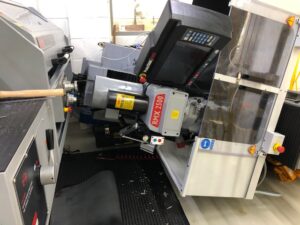
Engineering company Kent Auto Developments Limited was fined £18,349 (inc.costs) after a worker suffered injuries after becoming entangled in a metal working lathe whilst using hand-held emery cloth.
The circumstances were:
  • On  10 August 2020, Joshua Halls was completing the process of polishing brake drums for a Mini, rotating on a manual metalworking lathe. 
  • Joshua was applying emery cloth by hand, a practice condoned by the company, 
  • The business had failed to implement a safe system of work.
  • Employees routinely polished brake drums with emery cloth by hand on the lathe, a task known to be dangerous due to the potential risk of entanglement of the cloth in the rotating parts of the lathe, which can result in serious personal injury.
  • He was drawn into the machine which resulted in lacerations to his forearm and injuries to his neck and face.
  • The incident was not RIDDOR-reported until three months after the incident.
  • If the requirement to use emery cloth on a lathe is unavoidable, then tool posts and holding devices should be used.
The HSE inspector commented:
“We still see incidents like this, where unsafe work practices with machinery lead to injury, despite the existence of specific guidance published by HSE.
Workers coming into contact with machinery is the  fourth biggest cause of workplace fatalities in Great Britain, with 14 people  killed in the year 2020/21. Over 50,000 non-fatal injuries were reported by employers in the same year.
Employers should ensure that measures are taken to prevent workers from sustaining injury, where it is evident that persons are at risk of becoming entangled in machinery. It’s important that, when people do get hurt, the relevant authorities are notified so that action can be taken to prevent recurrence.”

Personal Protective Equipment Regulations now cover casual/contract workers

The Personal Protective Equipment at Work (Amendment) Regulations 2022 (PPER 2022) are now in force. They amend the 1992 Regulations (PPER 1992).

They now cover workers who generally have a more casual employment relationship and work under a contract for service; they were not included in the scope of PPER 1992.

What this means is that employers must provide the same type of PPE and instructions for casual/contract workers as they would for full-time employees.

Monday, 8 August 2022

Staircraft Group fined £206,477 after employee fell 3.5m from forklift truck whilst cleaning windows.

Carpentry and joinery company Staircraft Group Limited was fined £206,477 (inc. costs) after a man working unsecured on the forks of a fork-lift truck fell 3.5 metres to the ground.
The circumstances were:
  • On 14 June 2021 an employee was cleaning windows.
  • He was working from an unsecured stillage on the forks of a fork-lift truck in order to clean office windows at height.  
  • The company failed to identify that using a stillage to lift someone on the forks of a forklift truck, a method that they had used before, was unsafe.
  • There was a lack of training for employees on the dangers of working at height without the proper equipment .
  • There were no systems of work or risk assessments in place.
  • The stillage tipped and the employee fell 3.5 metres to the ground.  
  • As a result of the incident, he sustained a broken leg and an injury to his elbow.
The HSE inspector said:
“The employee’s injuries were very serious, and he could have easily been killed.
This serious incident could so easily have been avoided by simply carrying out correct control measures and safe working practices.
Companies should be aware that HSE will not hesitate to take appropriate enforcement action against those that fall below the required standards.”

Dyson fine £1.2M + costs after accident when moving a machine tool

Technology firm Dyson was fined £1,211,511 (inc costs) after an employee sustained head and chest injuries when moving a machine tool.
The circumstances were:
  • On August 27, 2019.a milling machine weighing 1.5 tonne was being moved at the Tetbury site.
  • Dyson Technology Limited failed to provide suitable and sufficient information, instruction, and training to those undertaking the task. 
  • They also failed to adequately assess the task and devise a safe system of work to ensure the machine was moved safely.
  • Two employees lifted the machine using a five-tonne jack.
  • They were in the process of replacing two fixed roller skates with several wooden blocks when it fell.
  • One of the employees was struck by the machine and sustained a wound to his head and injuries to his chest.
The inspector said:
“This incident could have been fatal. Those in control of work have a duty to assess the risks, devise safe methods of working and to provide the necessary information, instruction, and training to their workforce.
“Had a suitable safe system of work been in place this incident and the related injuries could have been prevented.”

Thursday, 23 December 2021

Precision Colour Printing fined £28,547 for two accidents where risk assessments were inadequate

Precision Colour Printing was fined £28,547 (inc.costs) for safety breaches after two employees were injured in separate incidents involving a printing press and a palletising machine.

The circumstances were:

  • The risk assessments in place were not suitable and sufficient
  • They did not consider the risks of clearing blockages or dealing with misaligned paper logs.
  • As a consequence, employees had not been provided with safe systems of work, sufficient information, instruction or training for such tasks.
  • On 17 October 2018, an employee sustained a de-gloving injury when his hand was dragged into the rollers of a printing press, as he cleared a blockage.
  • On 18 January 2019, another employee was dealing with a misaligned paper log on a palletiser machine. 
  • The clamping arm descended and crushed his hand, breaking his wrist.

The HSE inspector said:
“These incidents could so easily have been avoided by simply identifying and implementing appropriate control measures and safe working practices. 
Companies should be aware that HSE will not hesitate to take appropriate enforcement action against those that fall below the required standards.”

Goodwin Castings fined £138,000 after employee was burnt when molten slag was poured into a wet container outside

Goodwin Steel Castings Ltd., was fined £138,226 (inc.costs) for safety breaches after an employee suffered life-changing burns following an eruption of molten slag during a slag tipping procedure.

The circumstances were:

  • The management of the slag containers was inadequate. 
  • They were regularly stored incorrectly outside with the open face up, allowing water ingress.
  • The measures in place to inspect and ensure they were free from water contamination before use were also not adequate.
  • On 21 February 2020, slag was being poured into a container which was incorrectly stored outside during a period of stormy weather. 
  • Water had accumulated in the container, though it was not visible to the naked eye. 
  • When the molten slag was poured into the container, it reacted with the water causing a violent eruption.
  • The employee, pouring the slag sustained burns to a third of his body including his face, neck, stomach, arms, legs and feet, which required multiple skin grafts.

The HSE inspector said:
“This injury could easily have been prevented – the risk should have been identified and controls implemented. 
Relevant industry sectors are reminded of the need to ensure that all material and equipment likely to make contact with molten material is free from water contamination as far as they possibly can.”